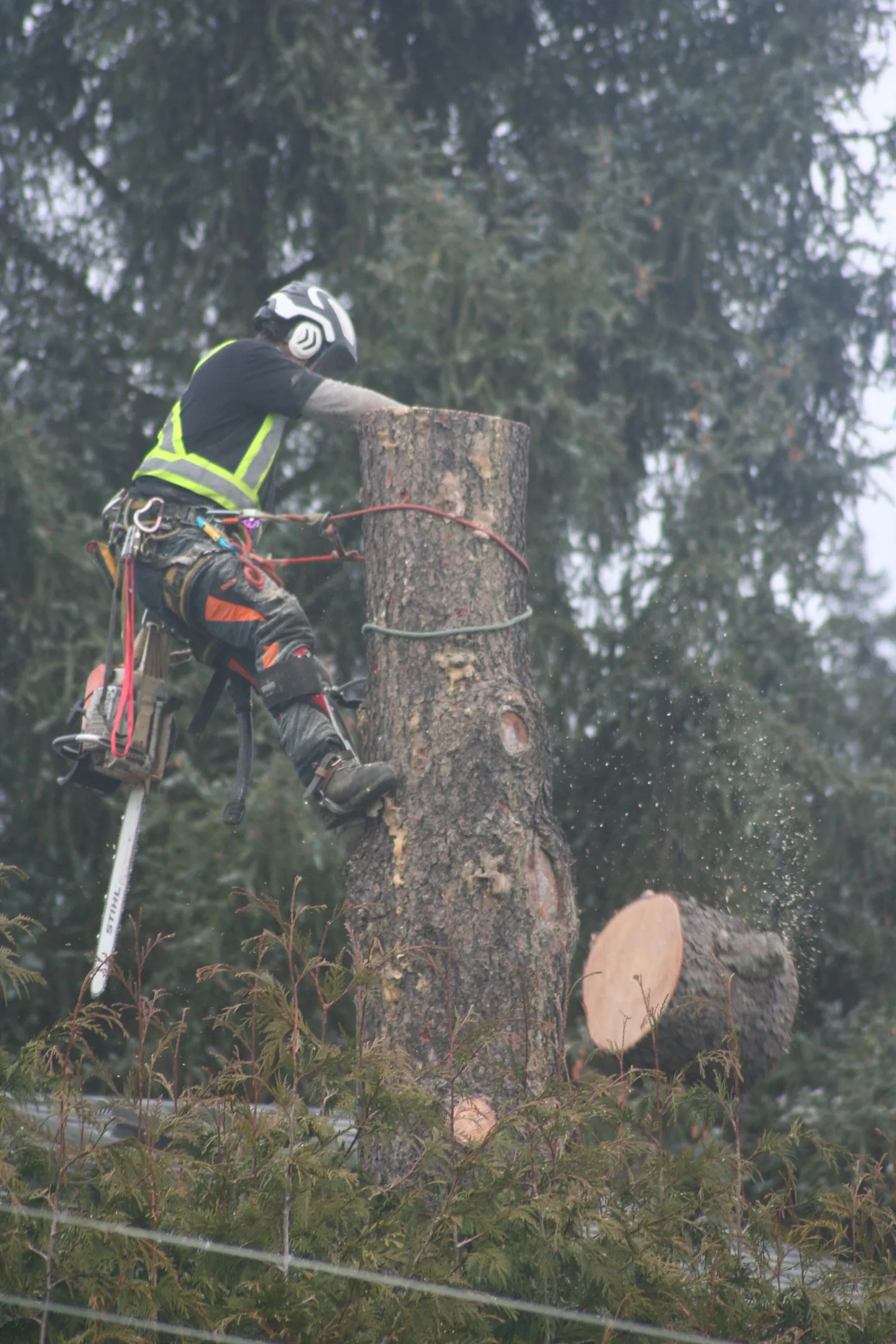
A dead tree, damaged trunk or hanging limb calls for a careful assessment. Dogwood reviews hazard-tree concerns and removal options with the surrounding property, access and tree condition in mind.
A hazard-tree concern needs both tree-condition information and an understanding of what could be affected. A new change warrants assessment; a photograph alone cannot certify a tree safe.
Describe what has changed
A new lean, split, broken branch or visible root movement is different from a tree that has grown at an angle for years. Tell us when you noticed the change, what the tree could reach and whether recent wind or work affected the site.
Keep the area clear
Avoid entering the area beneath damaged branches or working on a compromised tree yourself. If a tree or branch is in contact with electrical equipment, keep clear and contact the utility. For an immediate threat to life, contact emergency services first.
Consider the available options
Depending on the condition, the appropriate next step may be pruning, further assessment or removal. A visual concern does not establish that a tree must be felled. The job plan also needs to account for protected-tree rules and safe access.
Look at the change and the surroundings
Describe a fresh split, hanging branch or root movement and when you first noticed it. Also explain whether the tree is beside a home, driveway, frequently used path or open ground. These details help establish the enquiry’s urgency. A hazard concern is not a request to test the tree yourself: keep people out of the affected area and seek the appropriate response.
A removal quote is different from a formal risk report
An initial visit can discuss practical pruning or removal options, but a documented risk assessment may require a particular qualification, method and deliverable. If an insurer, municipality or property manager has requested a report, send the exact wording. Confirm the suitable provider and fee rather than assuming a general quote fulfils that requirement.
Visible change is the starting point for assessment
A new crack, suspended limb or movement near the roots deserves a focused enquiry. Describe what changed, when it happened and what occupies the space below. A tree’s size or lean alone is not a complete risk assessment, and photographs cannot establish every structural condition.
Your concern
An approach to discuss
What matters
A newly hanging or broken limb
Keep the affected area clear and seek assessment.
Do not approach beneath the material to obtain a closer photograph.
A tree near frequently used space
Assess the tree together with the people and structures nearby.
The consequence and use of the area matter alongside the observed defect.
A formal risk decision required
Confirm the assessment deliverable and qualifications.
A written risk assessment, a permit report and a removal quote are distinct scopes.
A hazard enquiry may lead to more than one option
Appropriate pruning, a changed use of the area, monitoring or removal may need comparison after assessment. The available options depend on the tree and setting. A website description cannot establish that a particular tree must come down or that retained trees have no future risk.
If removal is selected, permissions, suitable handling and material disposal still need a clear plan. Explain electrical lines, access restrictions and any recent storm damage when you call. Response availability must be confirmed directly; an online request is not a dispatched emergency crew.
Prepare a useful enquiry
What changed and when, viewed only from a safe location.
Buildings, routes and occupied areas near the tree.
Any existing report, authority request or electrical-line concern.
Plan hazard & dangerous tree removal for your community
Property conditions and current requirements differ across the region. Explore local planning for Victoria, Saanich, Langford, Colwood and other service areas, then provide the exact address for assessment arrangements.
Our tree-service pricing page explains the cost factors and inclusions to discuss. Before removal, major pruning or property changes around retained trees, check the local tree-permit guide and relevant authority.
Clear advice, from the start
Hazard & Dangerous Tree Removal in Victoria: detailed answers.
Understand your options before you book.
Does a leaning tree always need removal?+
No. A lean alone does not establish the risk. A recent change, root movement, cracks and the surrounding targets are reasons for a closer assessment.
Does visible decay prove that a tree must be removed?+
Visible decay is a reason for assessment, but its appearance alone does not establish the entire tree’s condition or the suitable response. Location, structural changes and the surrounding targets matter. A closer investigation may be required. Avoid relying on an online photo opinion as certification that the tree is safe or unsafe.
What should I do about a broken limb hanging above a walkway?+
Keep people out of the area and call to discuss the next available assessment. Do not stand beneath it or try to pull it free. If it presents an immediate threat to life, contact emergency services. Where electrical equipment is involved, stay clear and contact the utility.
Is an old lean different from a tree that has just started leaning?+
A recent change provides different information from a longstanding growth habit. Fresh movement, disturbed soil or cracks should be reported when arranging an assessment. Neither observation by itself establishes the correct work. Tell us when the change occurred and what is within reach of the tree.
Can a hazardous branch be removed while retaining the rest of the tree?+
That may be an option where the branch concern can be addressed and the remaining tree is suitable to retain. The assessment must consider the wider structure and condition. Ask for the pruning option and its limitations to be explained, rather than assuming either full removal or branch removal will resolve everything.
Are protected dead or dangerous trees automatically exempt from permits?+
Do not assume an exemption. Municipal procedures can apply even where a tree is dead or a hazard concern has been raised. Contact the responsible authority about the particular circumstances and any urgent-work procedure. Keep relevant photographs and share the authority’s instructions before arranging the work.
How can a property manager prioritize several tree concerns?+
List each tree separately, describe the observed change and identify nearby occupied areas or buildings. Include site access and any requested documentation. The assessment can distinguish concerns needing earlier attention from routine maintenance. A formal prioritization or risk inventory requires its own agreed scope and suitable provider.